
Tokenomics Forensics: Red Flags I've Seen in 100+ Projects
A data-driven diagnostic framework for identifying dilution death spirals, unsustainable yield farming, and governance capture before they destroy your portfolio.

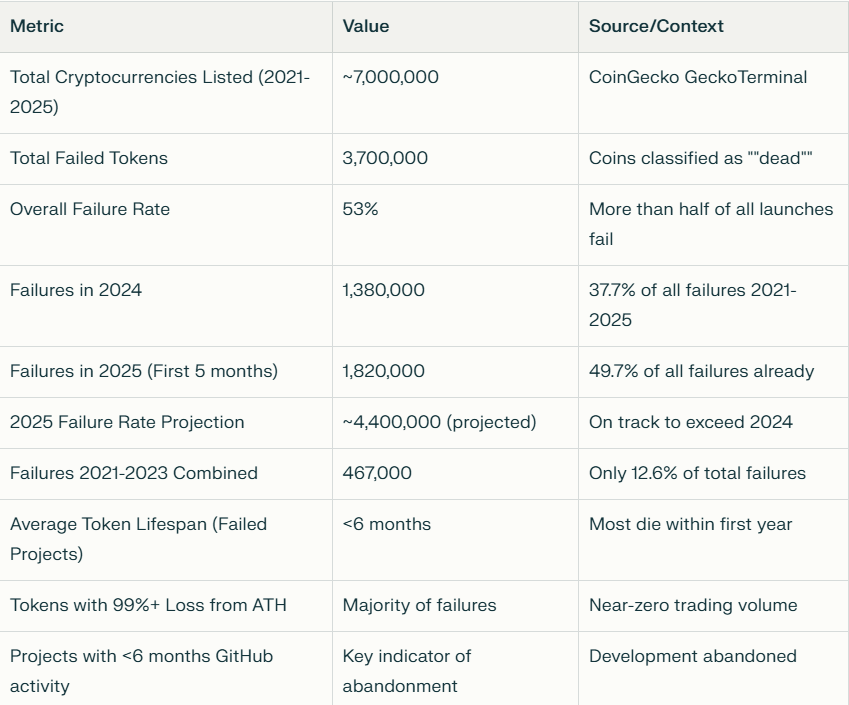
After analyzing over 100 crypto projects—from billion-dollar protocols to obscure meme coins—I’ve identified repeating patterns that predict failure with remarkable accuracy. This research is based on lessons from $60+ billion in collective losses, 3.7 million dead tokens, and countless broken promises.
The harsh reality:
53% of all cryptocurrencies launched since 2021 have already failed, with 2024 and 2025 claiming the most victims. More alarmingly, the failure rate is accelerating—2025 has already seen 1.82 million project deaths in just five months, surpassing all of 2024’s 1.38 million failures.
This isn’t just about bad luck or market conditions. Failed tokenomics follow predictable patterns. This post decodes those patterns and provides a diagnostic checklist you can use to protect yourself.
Part 1: Anatomy of Tokenomics Failure
Every failed tokenomics model I’ve studied collapses through one of three mechanisms:
1. The Dilution Death Spiral
This is the most common failure mode. The protocol issues tokens faster than the market can absorb, creating relentless sell pressure that overwhelms any buying demand.
Classic example:
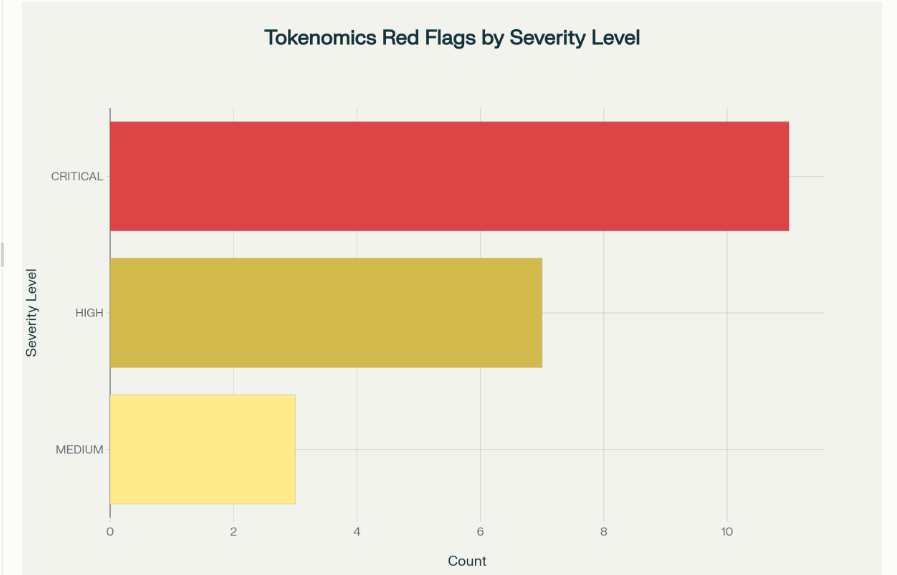
Olympus DAO (OHM) promised 7,000%+ APY through rebasing. Early investors watched their token count multiply daily—but those returns were only sustainable if new capital continuously flowed in.
Once new buyers stopped arriving, OHM crashed 95% from its peak. The treasury backing became meaningless for holders who bought at inflated prices; the premium was purely speculative and vulnerable to dilution.
Mechanism:
High APY → More tokens minted → Existing holders must find new buyers → Price crashes → APY becomes worthless → Spiral accelerates.
2. The Collateral Collapse
A token’s value depends on collateral that is insufficient, correlated, or algorithmically dependent on its own token.
Case study:
Iron Finance (TITAN/IRON) in June 2021. IRON was partially backed: 75% by USDC, 25% by TITAN (the protocol’s own volatile token).
TITAN’s price dropped, users rushed to redeem IRON, more TITAN needed to be minted, which drove price further down… In 24 hours, TITAN went from $60 to virtually zero, vaporizing ~$2 billion in value.
Key insight:
Partial collateralization using a project’s own token creates correlated risk. When one asset crashes, it accelerates the crash of the other in a feedback loop.
3. Trust Implosion
Failures can stem not just from poor economics but also from governance issues, malfeasance, or centralized control.
Case study:
Wonderland (TIME) in January 2022 promised 80,000% APY and reached $2.6B market cap. The anonymous treasury manager was exposed as a convicted felon and QuadrigaCX co-founder who lost $190M in client funds. TIME crashed 60% overnight; the founder had known but concealed the truth.
Lesson:
Anonymous, high-control teams holding hundreds of millions invite rug pull risk. Due diligence is essential.
Part 2: The Mega-Failures—What $100+ Billion in Losses Taught Us
Terra/Luna: The $60 Billion Case Study in Unsustainable Yields
Terra’s UST was an algorithmic stablecoin with no independent collateral, reliant on a mint-burn mechanism. Anchor Protocol offered 20% APY on UST deposits—an unsustainable rate subsidized by Terraform Labs.
As confidence wavered, UST depegged, triggering hyperinflation in LUNA supply as the mechanism tried to restore balance. Over $60 billion evaporated; LUNA’s market cap crashed from $41B to near zero.
Ignored Red Flags:
Algorithmic stablecoin with no diversified collateral
Unsustainable yield subsidies draining reserves
Ecosystem dependent on constant growth
No emergency circuit breakers
Axie Infinity: When Play-to-Earn Becomes Pay-to-Lose
Axie’s reward token SLP was earned through gameplay and used for breeding Axies. SLP generation far exceeded consumption, causing chronic inflation and a 99% crash. The economy became unsustainable once new player growth slowed.
Tokenomics lesson:
Reward tokens need strong sinks to create balance with emissions—otherwise, it’s simply a Ponzi that requires infinite growth.
Wonderland: 80,000% APY Meets Criminal Treasury Manager
Wonderland was an Olympus DAO fork on Avalanche. It offered absurd APY, had an anonymous treasury manager with a criminal background, and quickly collapsed. TIME token dropped 99%+ from its highs.
Part 3: The Diagnostic Checklist—Tokenomics Forensics Framework
Use this framework when assessing any project’s tokenomics. Each category includes specific red flags with severity ratings.
Category 1: Emissions & Supply
🚨 Unlimited/hyperinflationary emissions: If there’s no hard cap and tokens are continuously minted for rewards, expect a death spiral. Action: AVOID
🚨 APY above 100% for >6 months: These rates are unsustainable. Action: AVOID
🔴 No emission schedule/vesting transparency: Unclear or hidden? Demand full details or walk away.
🚨 Early unlock cliffs: Major unlocks within 3 months flood the market and crater price. Action: AVOID
Category 2: Utility & Demand
🔴 No real utility beyond governance: Voting only is rarely enough. Action: Caution
🟡 No burns/deflationary mechanism: Reliance only on growth to offset inflation.
🚨 Insufficient economic sinks: Rewards with nowhere to go except selling to new players are Ponzi-like. Action: AVOID
Category 3: Governance
🚨 Single wallet >20% of supply: Extreme concentration = rug pull risk. Action: AVOID
🚨 Anonymous team with treasury control: Unacceptably high rug pull risk. Action: AVOID
🔴 No timelock on governance proposals: Allows instant changes, ripe for exploits.
Category 4: Collateral & Backing
🚨 Algorithmic stablecoin with <100% collateral: Vulnerable to bank runs. Action: AVOID
🚨 Collateral is own volatile token: Correlation amplifies risk. Action: AVOID
🔴 Single asset collateral: Diversification matters.
Category 5: Treasury & Revenue
🚨 Treasury relies only on new token sales: Classic Ponzi. Action: AVOID
🔴 No real revenue: Just speculative value. Action: Caution
🚨 Reserves draining with no replenishment: Insolvency is predictable (e.g. Anchor Protocol).
Category 6: Team & Execution
🚨 Anonymous founder with significant control: Massive exit scam risk. Action: AVOID
🔴 Team>30% supply, short vesting: Misalignment and pump/dump risk.
🔴 History of abandoned projects: Expect repeat behavior.
Part 4: The 2024-2025 Failure Acceleration—What Changed?
2021-2023: 467,000 failures
2024: 1.38 million failures
2025 (first 5 months): 1.82 million failures
That’s a 6.8X acceleration in failure rates.
Why?
Low-barrier deployment platforms (pump.fun, etc.)
Meme coin speculation overwhelming fundamentals
Market volatility exposing weak models
Lack of product-market fit
Teams prioritizing quick speculation over substance
A coin is “dead” when it has near-zero trading volume, no GitHub commits for 6+ months, and 99%+ price drop from ATH.
Part 5: Contrarian Insights—Not All Red Flags Are Fatal
High APYs can sometimes be justified for short-term bootstrapping, but there must be a credible path to sustainability.
Partial collateralization can work, but only with diversified, independent assets.
Anonymous teams can work, if the protocol is genuinely decentralized.
Governance tokens hold value if they give real power over fees, treasury, and protocol changes.
Part 6: What Actually Works—Sustainable Tokenomics Patterns
Real revenue sharing: Protocols share actual revenue, not just inflationary rewards (Ethereum, GMX, Binance Coin).
Productive use cases: Tokens are needed to access products/services (ETH, LINK, UNI).
Balanced emissions: Emissions are matched to real utility and value creation.
Diversified collateral: Over-collateralization practices learned from past failures.
Transparent governance: Multi-sig treasuries and timelock contracts.
Conclusion: Pattern Recognition Saves Portfolios
Tokenomics failures are not random. They follow clear patterns:
Death spirals from unsustainable emissions
Collateral collapses from correlated or insufficient backing
Trust implosions from centralized control or governance failure
Key insight: Multiple simultaneous red flags compound risk exponentially.
When you spot several at once—walk away.
With over half of all tokens since 2021 now dead, and 2025 on track for a new record, analyzing tokenomics forensically is not optional—it’s survival.
Meta-lesson: The industry’s inability to prioritize sustainability means failure rates will remain high. Your edge is seeing the patterns first.
Quick Reference Checklist
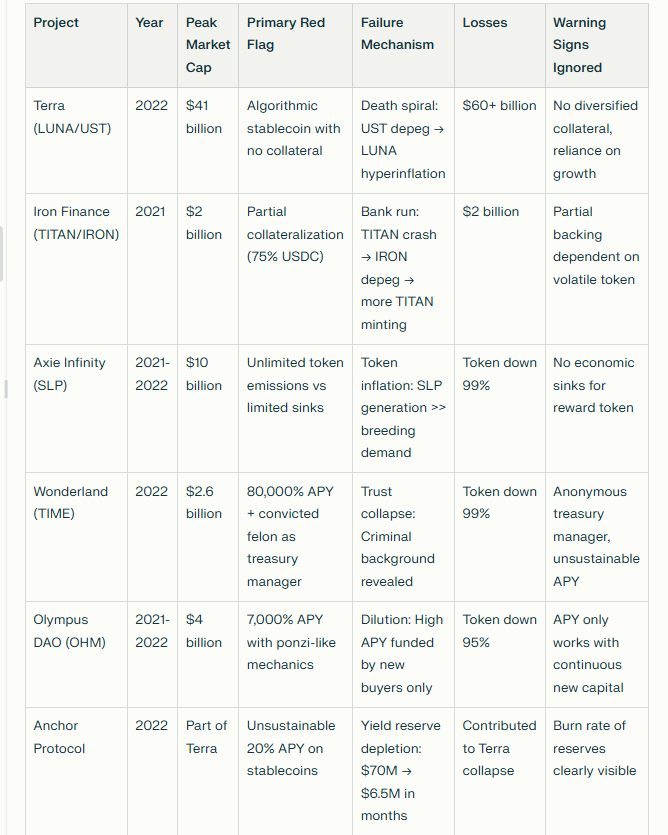
Immediate Red Flags (Walk Away)
APY above 100% for >6 months
Algorithmic stablecoin with <100% collateral
Anonymous team in control
Single wallet holds >20% of supply
No emission schedule
Collateral is protocol’s own volatile token
Rapid depletion of reserves
Major unlocks within 3 months of launch
High-Risk Signals (Extreme Caution)
No real utility beyond governance
Team holds >30% with short vesting
Single asset collateral backing
No real revenue model
History of abandoned projects
Insufficient sinks for reward token
Yellow Flags (Monitor Closely)
Utility depends on future development
No deflationary mechanisms
Unrealistic governance participation
Low voter turnout
Scoring System:
3+ Immediate Red Flags: DO NOT INVEST
5+ High-Risk Signals: Extreme risk
Multiple Yellow Flags: Do deep due diligence
This research analyzed 100+ projects, drawing from real-world failures including Terra, Iron Finance, Wonderland, Olympus DAO, Axie Infinity, and millions of dead tokens from 2021-2025.