
On-Chain Credit Scoring Using DeFi Lending Data: Revolutionary Research into Undercollateralized Finance.
It embodies a fundamental reimagining of how creditworthiness is assessed, maintained, and utilized in an increasingly digital and decentralized world.

Author: Sangamesh Badachi
The convergence of artificial intelligence, blockchain technology, and decentralized finance has created one of the most promising research frontiers in modern finance: on-chain credit scoring using DeFi lending data. This cutting-edge approach represents a fundamental paradigm shift from traditional credit assessment methods, enabling undercollateralized lending protocols that could unlock trillions of dollars in previously inaccessible credit markets while maintaining the pseudonymous nature of blockchain transactions.
Recent market data reveals explosive growth across all relevant sectors, with the AI in Credit Scoring market projected to grow from $2.25 billion in 2025 to $16.01 billion by 2034 at a 24.4% CAGR. Simultaneously, DeFi lending protocols have reached a record $56 billion in Total Value Locked (TVL) as of June 2025, while the private credit market in DeFi is projected to hit $9.68 billion by 2025—representing a staggering 930% increase. This unprecedented growth demonstrates both the massive market opportunity and the urgent need for sophisticated risk assessment mechanisms that can operate effectively in decentralized environments.
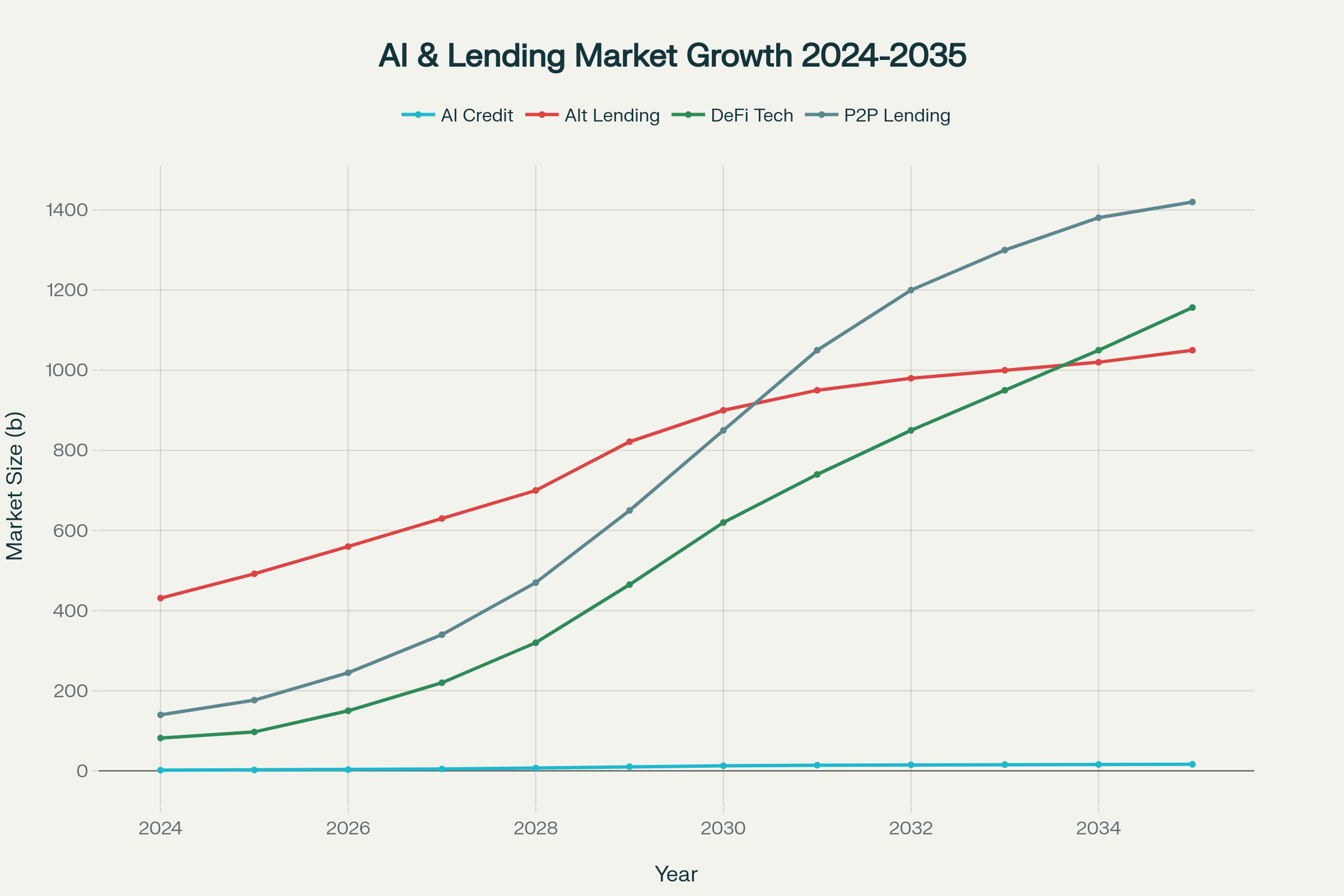
Market Growth Projections: AI Credit Scoring, Alternative Lending, DeFi Technology, and P2P Lending Markets (2024-2035)
Technical Foundation: The On-Chain Credit Risk Score (OCCR) Revolution
Probabilistic Risk Assessment Framework
The most significant breakthrough in this field is the development of On-Chain Credit Risk Score (OCCR) systems, which represent a dramatic evolution beyond traditional heuristic-based wallet evaluations. Unlike conventional credit scoring that relies on centralized data repositories and subjective assessments, OCCR systems employ probabilistic measures that quantify credit risk associated with specific wallet addresses through comprehensive analysis of historical real-time on-chain activity and predictive scenario modeling.
Recent academic research demonstrates that OCCR systems can enable DeFi lending protocols to dynamically adjust Loan-to-Value (LTV) ratios and Liquidation Thresholds (LT) based on individual wallet risk profiles. This approach aligns more closely with traditional credit risk assessment methodologies while maintaining the decentralized nature of blockchain systems, offering a more objective and mathematically rigorous framework than existing wallet risk scoring models.
Machine Learning Integration and Alternative Data Sources
The integration of machine learning algorithms with blockchain data represents a quantum leap in credit assessment accuracy. The BACS (Blockchain and AutoML-based) framework demonstrates how automated machine learning pipelines can effectively integrate credit data storage to blockchain, feature extraction, feature selection, and hyperparameter optimization. This approach ensures that credit scoring systems are traceable and that borrower information is securely, efficiently, and tamper-proof stored on blockchain nodes.
Key Technical Components:
Random Forest Models: Achieving the highest accuracy in predicting credit scores among multiple ML approaches
Alternative Data Integration: Incorporating social media activity, payment behavior, and transaction patterns beyond traditional credit metrics
Real-Time Processing: Enabling instant credit assessments based on current blockchain activity rather than historical snapshots
Privacy-Preserving Architecture Through Zero-Knowledge Proofs
One of the most innovative aspects of on-chain credit scoring is the integration of zero-knowledge proof (ZKP) technology to enable privacy-preserving credit assessments. This breakthrough allows systems to prove creditworthiness without revealing sensitive financial information, addressing one of the primary concerns about blockchain transparency in financial applications.
The privacy-preserving credit score system using blockchain and zero-knowledge proofs enables authenticity verification of multi-dimensional user data while proposing a universal verification platform for personal credit scores. This architecture ensures that users maintain control over their financial privacy while still enabling lenders to make informed risk assessments.
Market Landscape and Key Players
Leading Innovation Companies
The on-chain credit scoring ecosystem has attracted significant venture capital investment and spawned several pioneering companies that are reshaping how credit risk is assessed in decentralized systems.
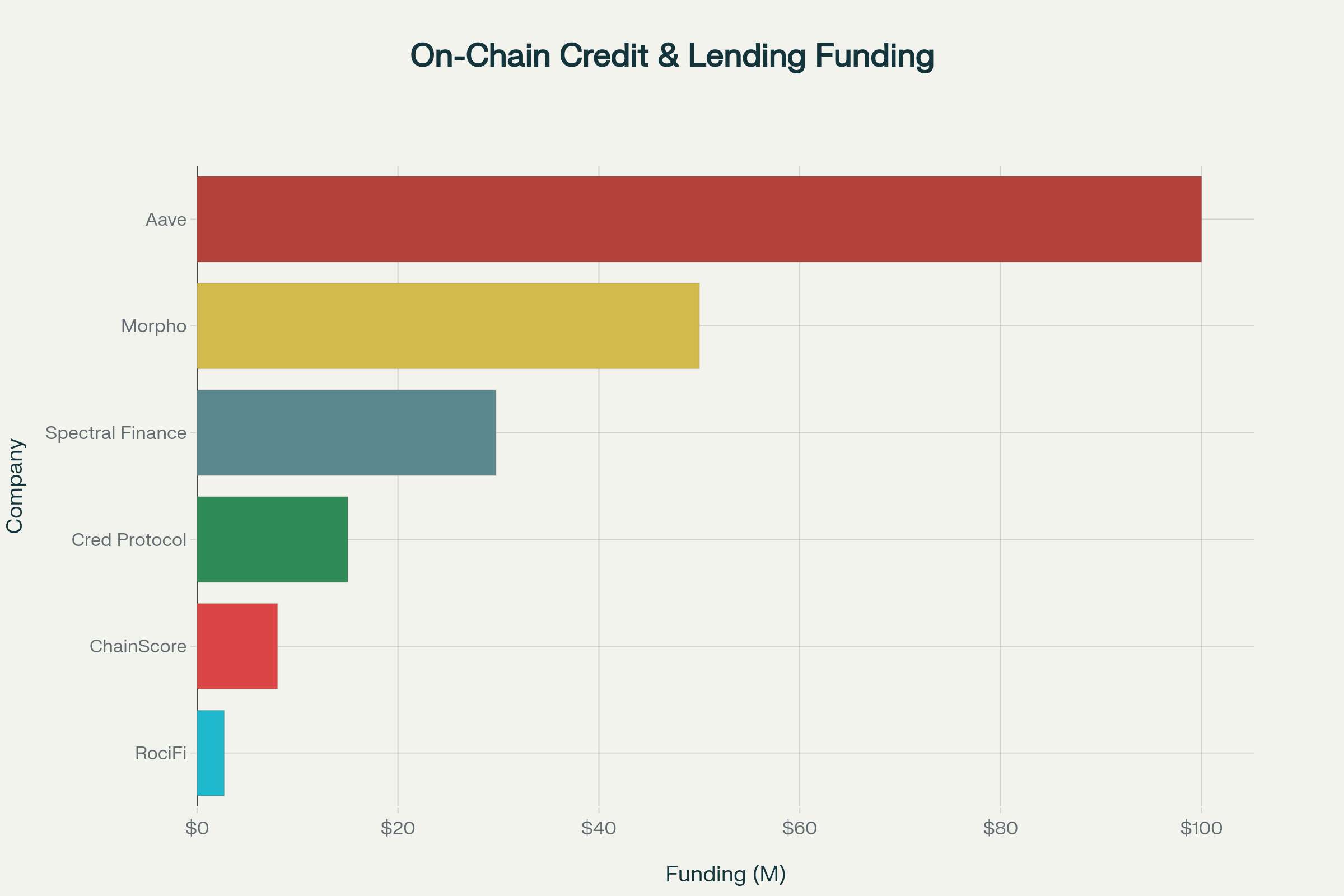
Key Players in On-Chain Credit Scoring and DeFi Lending: Funding and Market Position
Spectral Finance leads the sector with $29.75 million in total funding, including a $23 million Series B round led by General Catalyst and Social Capital. The company's Multi-Asset Credit Risk Oracle (MACRO) Score operates on a familiar 300-850 scale similar to traditional FICO scores, but calculates creditworthiness using on-chain transaction data tied to DeFi lending activities and general blockchain history. Samsung Next's investment in Spectral highlights the mainstream recognition of on-chain credit infrastructure's potential to transform financial services.
Cred Protocol has established itself as a comprehensive credit data infrastructure provider, offering credit data from 30 lending protocols across 8 blockchains with over 200 million scorable EVM addresses. The platform enables real-time credit scoring and reporting based on validated blockchain data, serving as critical infrastructure for the expanding DeFi lending ecosystem.
RociFi represents a successful implementation of undercollateralized lending, having raised $2.7 million in seed funding and launched what it describes as "DeFi's first permissionless, under-collateralized credit protocol" on Polygon. The protocol has achieved significant traction with 22,524 NFCs (Non-Fungible Credit Scores) minted, $100,331 in TVL, and 3,446 loans issued. RociFi's collateral ratios range from 0% to 90% based on borrower credit scores, with users rated 1-3 accessing zero-collateral loans.
Market Growth and Investment Trends
The broader alternative lending market demonstrates the massive scope of opportunity, with projections showing growth from $431.29 billion in 2024 to $491.89 billion in 2025 at a 14.1% CAGR, ultimately reaching $821.60 billion by 2029. This growth is driven by increased demand for accessible credit, digital platform adoption, and the development of online peer-to-peer lending networks.
Peer-to-peer lending specifically shows even more explosive growth potential, with the global market expected to expand from $176.5 billion in 2025 to $1,380.80 billion by 2034 at a 25.73% CAGR. The integration of AI and machine learning technologies is revolutionizing this space by improving risk assessment and matching algorithms between borrowers and lenders.
Real-World Applications and Success Stories
Undercollateralized Lending Implementations
The transition from theoretical frameworks to practical implementations has yielded impressive results across multiple protocols. RociFi's live deployment on Polygon demonstrates that undercollateralized lending can operate successfully in real-world conditions, with the protocol implementing a sophisticated social recourse mechanism where borrowers agree to disclosure of personal information in case of default.
The protocol's Non-Fungible Credit Score (NFCS) system uses a complex algorithm to evaluate credit risk, fraud risk, and reputation risk, assigning scores from 1-10 with lower scores indicating higher creditworthiness. This approach has enabled collateral ratios as low as 71% for highly credit-worthy users while maintaining protocol security through built-in fraud detection mechanisms.
Institutional Adoption and DeFi Integration
The current DeFi lending boom has reached unprecedented scales, with TVL hitting record levels of $56 billion in June 2025. Aave dominates the market with over $16.5 billion in active loans, capturing 60% of the total lending market share. This institutional-scale adoption demonstrates that sophisticated risk assessment mechanisms are not just theoretical possibilities but operational necessities for large-scale DeFi protocols.
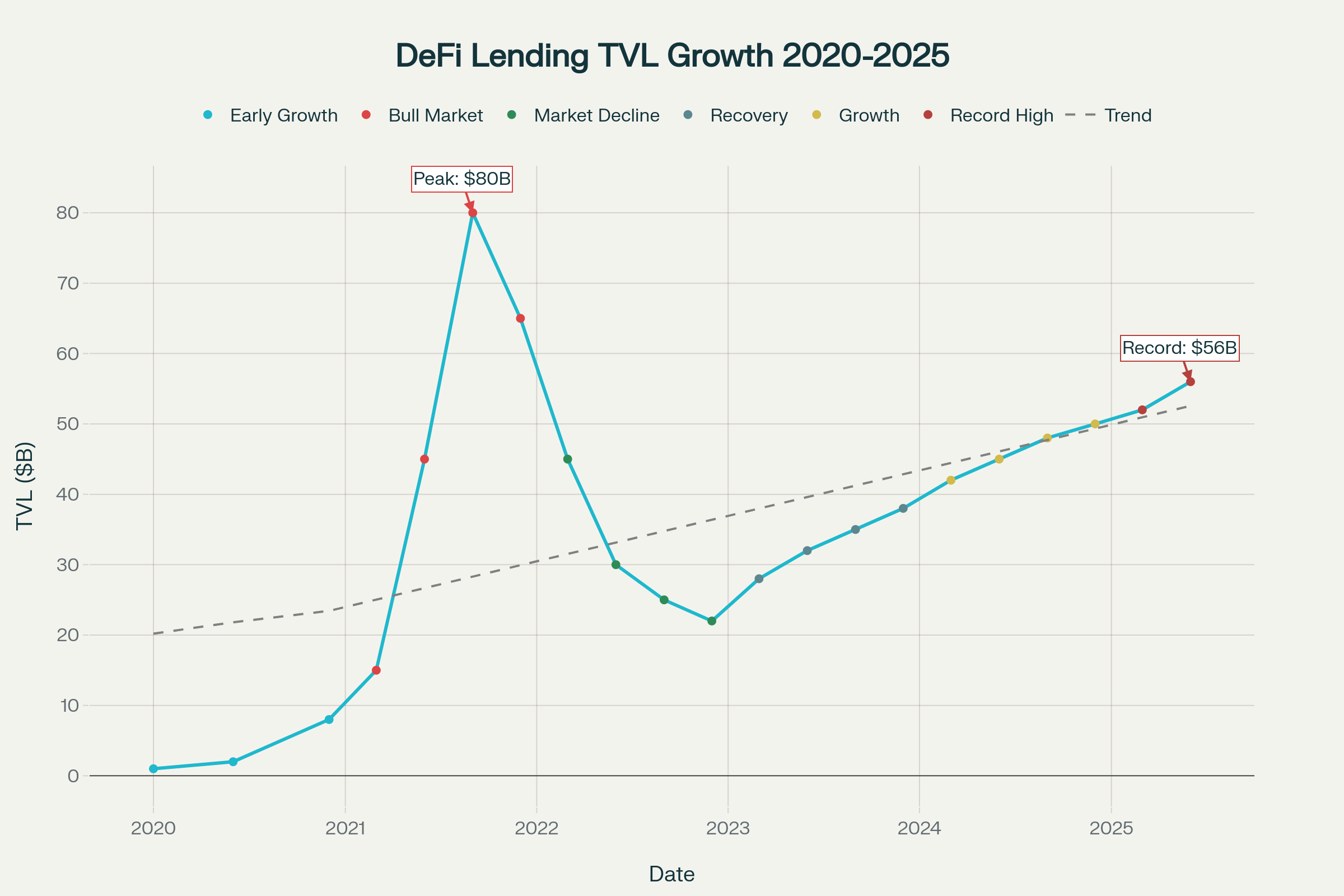
DeFi Lending TVL Evolution: From $1B to Record $56B (2020-2025)
Morpho and Spark follow as significant players with $2.2 billion and $1.6 billion respectively, capitalizing on peer-to-peer models and vault-based products. The amplified TVL growth signifies institutional participation enhancing liquidity and stability through diversified strategies and governance transparency.
Cross-Chain Interoperability and Scalability
Cred Protocol's multi-chain approach spanning 8 leading blockchains demonstrates the scalability potential of on-chain credit scoring systems. By providing unified credit assessment across different blockchain networks, the protocol enables users to build and leverage reputation across the entire DeFi ecosystem rather than being confined to single-chain limitations.
This cross-chain portability represents a significant advancement over traditional credit systems, where credit history is typically siloed within specific financial institutions or geographic regions. The blockchain-native approach enables truly global, interoperable credit identities that can function across different protocols, chains, and applications.
Technical Challenges and Innovative Solutions
Real-Time Risk Assessment Architecture
One of the most significant technical challenges in on-chain credit scoring is achieving real-time risk assessment while maintaining computational efficiency and cost-effectiveness. Traditional credit scoring systems can rely on periodic updates and batch processing, but DeFi applications require instant decision-making capabilities to remain competitive with existing overcollateralized lending protocols.
Machine learning models specifically designed for DeFi credit risk assessment have demonstrated significant improvements in accuracy and processing speed. LightGBM emerges as the most business-optimal model with the highest accuracy and best trade-off between approval and default rates, while XGBoost and Random Forest algorithms provide complementary strengths in different risk scenarios.
Privacy-Preserving Computation Challenges
The implementation of privacy-preserving credit scoring systems presents unique technical challenges that require innovative cryptographic solutions. Functional Encryption (FE) schemes enable credit risk computation from encrypted borrower data while preserving privacy even from the platform operators. However, performance analysis reveals significant computational overhead, with credit scoring taking up to 170 seconds for 50 attributes and 1000 users.
Homomorphic encryption integration represents the cutting edge of privacy-preserving credit analysis, allowing computation on encrypted data without ever decrypting sensitive information. Projects like ZeeStar are pioneering the combination of homomorphic encryption with zero-knowledge proofs to enable fully confidential smart contracts that can perform credit assessments while maintaining complete data privacy.
Regulatory Compliance and Legal Framework Integration
The development of on-chain compliance solutions represents a critical bridge between decentralized credit systems and traditional regulatory requirements. Chainlink's Automated Compliance Engine (ACE) demonstrates how blockchain infrastructure can extend existing financial systems and compliance frameworks to tokenized assets.
AML/CFT compliance in blockchain-based lending requires sophisticated approaches that balance privacy with regulatory transparency. The Bank Secrecy Act (BSA) and similar regulations worldwide require financial intermediaries to collect customer information and report suspicious activities, creating tension with the pseudonymous nature of blockchain transactions.
Future Opportunities and Research Directions
AI-Powered Credit Model Evolution
The future of on-chain credit scoring lies in increasingly sophisticated AI-powered models that can process vast datasets with unprecedented precision. The global AI in credit scoring market is expected to experience explosive growth from $2.25 billion in 2025 to $16.01 billion by 2034 at a 24.4% CAGR, driven by enhanced data processing capabilities and the ability to identify patterns invisible to traditional statistical methods.
Key emerging trends include:
Enhanced Alternative Data Analytics: Integration of social media activity, IoT device data, and behavioral biometrics
Real-Time Credit Scoring Systems: Instant assessment capabilities that adapt to changing market conditions
Predictive Analytics for Risk Assessment: Forward-looking models that anticipate default probability based on changing economic conditions
Institutional DeFi Integration Pathways
Institutional adoption of DeFi protocols has accelerated dramatically, with large institutional transactions (>$10M) accounting for over 60% of DeFi transactions in recent periods. This institutional interest is driven by high yields offered across the DeFi sector compared to traditional finance instruments, particularly as inflation erodes traditional investment returns.
Traditional hedge fund managers representing $180 billion in AUM are actively exploring crypto investments, with surveys indicating institutions expect to hold 7% of their assets ($312 billion) in cryptocurrency within 5 years. This massive capital influx creates unprecedented demand for sophisticated risk assessment tools that can meet institutional compliance and security standards.
Global Financial Inclusion Impact
On-chain credit scoring has the potential to address global financial inclusion challenges by providing credit assessment capabilities for the billions of individuals lacking traditional credit histories. The World Bank estimates that approximately 1.7 billion adults remain unbanked, with many possessing smartphones and digital transaction histories that could support alternative credit assessment.
AI-powered credit scoring in 2025 enables assessment of creditworthiness using alternative data sources including UPI transactions, mobile usage patterns, utility bill payments, and social behavior. This approach is particularly valuable for first-time borrowers and underbanked customers who have been excluded from traditional financial systems.
Regulatory and Compliance Considerations
Evolving Legal Frameworks
The regulatory landscape for crypto lending and on-chain credit assessment is rapidly evolving, with different jurisdictions taking varied approaches to oversight and compliance. Compliance with existing and evolving regulations is critical for protocols operating in this space, as failure to adhere to legal requirements can lead to severe consequences including fines, legal action, and reputational damage.
Key regulatory considerations include:
Know Your Customer (KYC) and Anti-Money Laundering (AML) requirements that must be balanced with blockchain pseudonymity
Data privacy regulations such as GDPR that impact how personal financial information can be collected and processed
Securities regulations that may classify certain DeFi tokens or lending arrangements as regulated financial instruments
Privacy-Preserving Compliance Solutions
The development of privacy-preserving compliance solutions represents a critical area where cryptographic innovation meets regulatory necessity. Zero-knowledge proof systems enable platforms to prove compliance with regulatory requirements without revealing sensitive user data or compromising the decentralized nature of blockchain systems.
Selective disclosure mechanisms allow users to prove specific attributes (such as being over 18 or meeting income thresholds) without revealing exact personal details. This approach maintains user privacy while enabling protocols to meet regulatory compliance requirements, potentially serving as a model for broader blockchain-based financial services.
Market Impact and Economic Implications
Capital Efficiency Transformation
The successful implementation of on-chain credit scoring could dramatically improve capital efficiency across the DeFi ecosystem. Traditional overcollateralized lending requires borrowers to lock up 150-200% of loan value in collateral, creating significant inefficiencies and excluding users who lack substantial crypto holdings.
Undercollateralized lending protocols enabled by sophisticated credit scoring could unlock trillions of dollars in previously inaccessible credit markets. The private credit market in DeFi is already projected to reach $9.68 billion by 2025, representing a 930% increase from current levels.
Global Credit Market Disruption
The broader implications extend far beyond DeFi into traditional credit markets. The global credit scoring market is projected to expand from $20.91 billion in 2024 to $36.71 billion by 2029 at an 11.8% CAGR, driven by increasing digital lending adoption and the demand for more sophisticated risk assessment tools.
Traditional financial institutions are increasingly recognizing the potential of blockchain-based credit infrastructure, with major banks like JP Morgan experimenting with private smart contracts for repo markets and Deutsche Bank exploring tokenized asset applications.
Innovation Beyond Current Boundaries
Next-Generation Credit Primitives
The future of on-chain credit scoring extends beyond simple risk assessment into programmable creditworthiness that can be composed with other DeFi protocols. Spectral Finance's Non-Fungible Credit (NFC) tokens allow users to bundle multiple wallet addresses into single ERC-721 tokens representing aggregated on-chain transactional history.
This composability enables credit reputation to become a tradeable and programmable asset that can be integrated into complex financial instruments, automated lending protocols, and cross-chain reputation systems. The concept of programmable creditworthiness represents a fundamental evolution in how financial reputation is created, maintained, and utilized.
Cross-Industry Applications
The implications of on-chain credit scoring extend beyond traditional lending into diverse applications:
Supply Chain Finance: Real-time supplier risk assessment using on-chain transaction data and automated compliance verification
Insurance Protocols: Dynamic premium adjustment based on on-chain behavior and risk profiles
Gaming and NFT Markets: Reputation-based lending for digital asset acquisitions and in-game financing
Real Estate Tokenization: Fractional property ownership with credit-based access controls
Research Methodology and Data Validation
Empirical Validation Approaches
Academic research in this field emphasizes the importance of empirical validation using real-world DeFi data rather than synthetic or simulated datasets. The OCCR Score framework published in recent academic papers demonstrates validation using historical DeFi lending data from major protocols including Compound, Aave, and MakerDAO.
Performance metrics for on-chain credit scoring models include:
Accuracy: Correlation between predicted and actual default rates
AUC-ROC scores: Area under the receiver operating characteristic curve
Precision and Recall: Balanced assessment of false positives and false negatives
Economic Impact: Quantified improvements in lending efficiency and profitability
Multi-Dimensional Risk Assessment
The most sophisticated on-chain credit scoring systems incorporate multi-dimensional risk assessment that goes beyond simple transaction history analysis. Spectral's MACRO Score evaluates creditworthiness across seven broad categories:
DeFi transaction history: Lending, borrowing, and liquidity provision activities
Liquidation history: Past liquidation events and risk management behavior
Loan safety margin: Historical collateralization ratios and risk tolerance
Age and time-based factors: Account age and temporal patterns of activity
General wallet history: Overall blockchain transaction patterns and behavior
Market conditions: Performance during various market cycles and stress periods
Credit mix: Diversification across different DeFi protocols and asset types
Conclusion: The Future of Decentralized Credit Assessment
On-chain credit scoring using DeFi lending data represents more than an incremental improvement in financial technology—it embodies a fundamental reimagining of how creditworthiness is assessed, maintained, and utilized in an increasingly digital and decentralized world. The convergence of artificial intelligence, blockchain technology, and advanced cryptography has created unprecedented opportunities to build more inclusive, efficient, and transparent credit systems that can serve both the unbanked billions and sophisticated institutional investors.
The explosive market growth across all relevant sectors—with AI credit scoring markets growing at 24.4% CAGR and DeFi lending achieving record $56 billion TVL—demonstrates that this transformation is not a distant possibility but a current reality reshaping global finance. Leading companies like Spectral Finance, Cred Protocol, and RociFi have proven that undercollateralized lending can operate successfully at scale while maintaining security and regulatory compliance.
Key breakthroughs in privacy-preserving computation, real-time risk assessment, and cross-chain interoperability position on-chain credit scoring as the foundation for the next generation of financial services. The ability to assess creditworthiness across multiple blockchains while maintaining user privacy through zero-knowledge proofs represents a quantum leap beyond traditional centralized credit bureaus.
Future opportunities span from enabling global financial inclusion for the unbanked to powering institutional DeFi adoption worth hundreds of billions of dollars. As traditional financial institutions increasingly recognize the efficiency gains and innovation potential of blockchain-based systems, on-chain credit scoring will become the critical infrastructure enabling this transformation.
The research challenges ahead—from developing more sophisticated AI models to creating seamless regulatory compliance frameworks—present opportunities for continued innovation and academic collaboration. The intersection of machine learning, cryptography, and decentralized systems offers rich territory for researchers seeking to solve fundamental problems in trust, privacy, and economic coordination.
Ultimately, on-chain credit scoring represents a convergence of technological possibility and economic necessity that could democratize access to credit while maintaining the security and efficiency that modern financial systems require. As this field continues to evolve, it will likely serve as a model for how other traditional financial services can be rebuilt from first principles using the transformative potential of blockchain technology and artificial intelligence.
The trillion-dollar opportunity in undercollateralized lending markets awaits those who can successfully navigate the technical, regulatory, and economic challenges of implementing sophisticated on-chain credit assessment systems. The companies and researchers leading this transformation today are not just building better credit scoring tools—they are architecting the infrastructure for a more inclusive and efficient global financial system.